Jamie Who is a blog about everything. Except current affairs. And politics. Also science, sport, religion, celebrities, movies, media and marketing, technology, business and design. So...basically Jamie Who is a blog about food. All things food.
Showing posts with label healthy substitute. Show all posts

Thursday, July 1, 2010

Ostrich and mushroom lasagne


I wrote in the past about some hake kebabs that arrived on my plate - and your screen - courtesy of The Queen. What you might not know is that she regularly cooks up pretty impressive stuff. After hustling me for the first 2 years (when I was convinced all she could do was a roast chicken) the cat is now very much out the bag. The girl has skizzills. This recipe is hers and I'll admit it is one of my favourite on this blog. The white sauce was homemade but it's not really necessary - you could easily just buy one. 

Stuff you'll need to feed 8 (or 2 of you. Umm...4 times):
  •  1 kg of ostrich mince
  • A box of the best lasagne sheets you can find. 
  • 1 x onion, finely chopped
  • 2 x tins of tomatoes
  • A handful of parsley, roughly chopped
  • About a tablespoon of tomato paste 
  • About a teaspoon of dried thyme
  • A handful of mixed mushrooms, roughly chopped
  • 1 x chilli, finely chopped
  • 2 x cloves of garlic, crushed
  • A handful of grated parmesan (I don't mean buy grated parmesan. Please, don't ever do that. Buy proper parmesan, grate it yourself. Come now) 
To make the white sauce (if you are backing yourself):
  • 1 and a half tablespoons of butter
  • About 3 tablespoons of flour (to start with. You might need more as you go) 
  • A litre of fat-free milk (we were keeping it healthy. Use whatever milk you want) 
Okay, what to do:

1. Pre-heat your oven to 180 degrees celsius. Gently fry your onions over medium heat for a few minutes until softened. 

2. Add the thyme, the chilli, the mince, the garlic and the mushrooms and fry for a few minutes more. 

3. Add the tomato paste, the tinned tomatoes and the parsley and bring to the boil. Season well, reduce heat and allow to simmer with the lid on for as long as possible. Depending on the time available, remove lid and allow sauce to reduce and thicken. 

4. In a suitable baking dish, layer white sauce, pasta sheets and mince mixture, repeating two or three times until the dish is full. Make sure the top layer is white sauce. 

5. Sprinkle grated cheese over the top and bake for 45 minutes. 

If you're making the white sauce:

Start by melting the butter. Remove from stove and start adding flour slowly mixing in to form little dough balls. Make sure flour is covered in butter. Slowly start adding your milk, continuously whisking. As the milk warms, the mixture will thicken. IT IS SUPER-IMPORTANT TO CONTINUE TO WHISK THE ENTIRE TIME. If you don't, lumps will form. This is a slow process so be patient. You might need to add some more flour at this point - if you do make sure the whisking doesn't stop. 

I'd serve this with a very simple herb salad. That was the plan. That was also the plan for the shoot, but when I put it on a white plate there was something about the simplicity of it that appealed. I loved it. Hopefully you do too. 

Cheers,
Jamie Who 


Wednesday, June 30, 2010

Beef braised in beer and served on butter beans


Beer is a highly underrated ingredient when it comes to cooking. It makes a great batter, it is awesome to braise meat in and it's pretty handy in a marinade/sauce. I'm talking about good beer. Real beer. Beer with depth of flavour and character. (The irony is that I'm writing this post after drinking my own body weight in Budweisier at last night's football. My word that stuff is average.) 

Anyway, the other night I got my hands on some free range beef and threw together a little stew using the beer I was drinking. It was good. Like...reaaalllllly good. You should try it sometime. 

Stuff you'll need to feed 2:
  • A dark beer (I used the dark lager from &Union) 
  • A tin of tomatoes
  • About 400g of free-range stewing beef, cubed
  • A handful of chopped celery
  • A teaspoon of coriander seeds, crushed
  • A teaspoon of dried thyme
  • A handful of parsley, chopped
  • A handful of chopped carrot
  • An onion, roughly chopped
  • A handful of mixed mushrooms, roughly chopped
  • A few leaves of sage to garnish
  • A cup of water
  • A chilli, roughly chopped
  • 2 cloves of garlic, roughly chopped
  • A tin of butter beans, drained (or your favourite beans) 
Okay, what to do:

1. Preheat your oven to 160 degrees celsius. Brown your meat over a high heat in some olive oil. Remove and set aside. 

2. Reduce heat and gently fry your onion, carrot and celery until soft. Add the mushrooms, chilli, herbs (except sage) and garlic and fry for an additional minute. 

3. Add the tinned tomatoes, the beer and the water and bring to the boil. Reduce to a simmer. 

4. Cook in the oven for 2 hours. (If you can, cook it longer at a lower temperature. The longer the better) 

5. About 30 minutes before serving, remove pot from oven and cook on the hob to reduce sauce to the desired consistency. 

6. To serve, spoon beans into a bowl and pour on some beef and sauce. Garnish with sage. 

You'll have to go a long way to find better comfort food than this. The beer is phenomenal in the sauce and plays a part in tenderising the meat. It is a healthy, hearty dinner and will impress anyone. Well...it should. If it doesn't (1) You're an idiot and you messed up or (2) They're an idiot and they should leave.  

Cheers,
Jamie Who 

Wednesday, June 23, 2010

Sweet potato gnocchi with shredded lamb shank


Who doesn't love lamb shank? In winter it must rate as one of the best comfort dishes around. Plus, it's super easy to cook. I usually make mine the night before and let it cook on a low temperature through the night. Serving it on the bone with polenta, parmesan mash, saffron rice etc. is cool, but what I like to do is shred the meat. It opens up so many options and you can create phenomenal things with it. I've used it in the past in a risotto which was sensational. The dish was pretty heavy though and I needed something a bit lighter when we hosted The In-Laws on Sunday. Enter gnocchi. 

Gnocchi is highly underrated. It is not overly difficult to make and when you use sweet-potato as I do it's a lot healthier than most starches. The other bonus is that you can always make extra dough and freeze it. In terms of exact amounts, it's a bit tricky. Just gauge as you go and add flour or water as necessary. 

Stuff you'll need to feed four:

For the gnocchi:
  • 3 - 4 sweet potatoes, peeled, cooked and mashed
  • A pinch of nutmeg
  • One free-range egg yolk
  • About 2 cups of flour plus extra for dusting 
For the sauce
  • 4 lamb shanks 
  • A handful of finely chopped carrot
  • A handful of finely chopped celery
  • An onion, finely chopped
  • Two tins of tomatoes
  • About half a bottle of red wine. (Good wine. Wine that you would drink happily)
  • A handful of hard herbs, chopped (Go for thyme, rosemary, oreganum or a combo)
  • Flour, for dusting the meat
  • A handful of parsley, roughly chopped
  • 1 - 2 chillies, finely chopped
  • 3 cloves of garlic, crushed
Okay, what to do:

For the gnocchi

1. Make sure the sweet-potatoes are well mashed and while they are still warm add flour, egg and nutmeg. Season well with salt and pepper and knead to make a warm, soft dough. If you need to add some flour or water do so. Cover with a tea towel for 5 minutes. 

2. Sprinkle your work surface with flour and roll out the dough to form a long, thin "sausage".

3. Using a sharp knife cut the dough into 1cm pieces. Use a fork and squash each piece to form ridges on one side. Place pieces on a floured baking tray. 

4. Bring a pot of salted water to the boil and cook gnocchi pieces in batches. What's pretty cool is that the gnocchi tells you when they are ready by rising to the surface. When this happens, scoop them out gently and put aside. 

For the shanks

1. Preheat your oven to 140 degrees celsius. Dust your shanks in flour and brown them in a deep pot. Remove and set aside. 

2. Gently fry your onion, carrot and celery in the pot for a few minutes and add your herbs, garlic and chilli. Fry for a bit longer before adding the tinned tomatoes and wine. Place your shanks in the liquid. They should be covered so you might need to add a glass or two of water. 

3. Bring to the boil before reducing heat to a simmer. Cook for 10 minutes before placing in the oven. 

4. Cook shanks for as long as you can (at least 2.5 hours but preferably 7 or 8!) Take the pot out and gently turn the shanks every now and then. 

5. When the meat is falling off the bone, remove shanks and set aside to cool. Shred meat. 

6. Add ladles of the sauce to a pan and reduce until desired consistency. Add the meat and heat through. 

To serve, spoon sauce into bowls, top with some gnocchi pieces and garnish with chopped parsley. 

Quite simply, an epic meal. 

Cheers,
Jamie Who


Thursday, June 17, 2010

"Caprese salad" soup


Look, in the food and wine world we know some ingredients belong together. Dark chocolate and raspberries. Mint and peas. Mushrooms and thyme. Shiraz and pepper. Tequila and Myprodol. Some things just work, you know? 

One of the most celebrated examples of flavours being best friends is the simple Caprese salad. Basil. Tomatoes. Mozzarella. Done. With the temperature being what it has the last few days (fu*king cold basically) I had a stab at trying to bring these flavours together in a way that would warm me up too. The result was a pretty cool "Caprese salad soup", which was a bit like a tomato soup dressed up for a night out. 

Stuff you'll need to feed 4:
  • Three handfuls of cherry tomatoes 
  • Two tins of tomatoes
  • A bunch of basil 
  • The best olive oil you can get your hands on 
  • About 500ml of the best chicken stock/vegetable stock you have (Check out NoMU's fonds range) 
  • About 12 balls of bocconcini, or the equivalent amount of mozzarella ripped into 12 pieces. 
  • Half an onion, finely chopped
  • 2 garlic cloves, crushed
  • A handful of finely chopped celery
  • A handful of finely chopped carrot
Okay, what to do:

1. Preheat your oven to 200 degrees celsius. Place your cherry tomatoes in a roasting tray, drizzle with olive oil and season. Roast for 35 minutes, or until they begin to blister. Remove and set aside. 

2. Meanwhile, gently fry your celery, onion, garlic, carrot in a pan until softened but not coloured. 

3. Add your tinned tomatoes and stock to the pan and bring to the boil. Reduce heat and allow to simmer. Add your roasted tomatoes. Allow to simmer for as long as possible, or until the liquid has reduced to your liking. 

4. Using a stick blender blitz mixture until smooth. (If you don't have a stick blender pour into normal blender and blitz.)

5. While soup is simmering, make a very rustic "pesto" by pounding the basil with some olive oil and sea salt in a pestle and mortar. 

6. To serve, ladle the soup into bowls and add three pieces of cheese to each bowl. Drizzle over the "pesto" and a bit of olive oil if you need to. Make sure to season with plenty of black pepper. 

This is - quite simply - cooking for dummies. Anybody can make this. It is more sophisticated than a tomato soup and way tastier. The cheese that melts into the soup is what makes the difference. It scores high on the health:taste ratio and is perfect for winter. Get moving. 

Cheers,
Jamie Who

Wednesday, May 26, 2010

Whole wheat penne with pork sausage, blistered tomatoes and chilli


Sausages. Jeez I miss them. With the whole free-range thing it has honestly been one of the toughest things to give up. So you can imagine how stoked I was to stumble across Open Veld organic and free-range sausages recently. Created by Ian Bergh (trained chef), they are not made from sinewy off-cuts (like most sausages in this country) but rather good quality meat, sourced from ethical suppliers. This means they add no preservatives and cereals or bread in order to bulk them up. They also use less fat, which is an added bonus. (Look, they need to use some fat to add flavour - and help as a binding agent - but they are definitely healthier than most.) There are a couple of flavours but the one I keep coming back to is the pork, garlic and white wine variety. It's fantastic. My favourite way to cook them is to cut them open, take out the meat and use it in a pasta. Here's what I mean:

Stuff you'll need to feed 4:
  • 500g organic, whole wheat pasta of your choice (I prefer a short pasta with a chunky sauce like this, so go for something like penne, farfalle or fusilli)
  • A punnet of Open Veld pork sausage
  • 2 chillies, finely chopped
  • Half an onion, finely chopped
  • 2 cloves of garlic, finely chopped
  • A handful of parsley, roughly chopped
  • A handful of basil, torn 
  • Half a tin of tomatoes
  • Three handfuls of rosa tomatoes
Okay, what to do:

1. Preheat the oven to 200 degrees celsius. Place your rosa tomatoes in a baking dish, pour over some olive oil, season with sea salt and black pepper. Roast for about 35 minutes, or until blistered.  Remove and set aside. 

2. Meanwhile, heat some olive oil in a pan and fry your onion until it softens. Add the garlic and chilli and cook for about 2 minutes more, making sure not to burn the garlic. 

3. Cut the sausage casing and remove meat. Add to the pan and fry until golden. 

4. Add the roasted tomatoes and the tinned tomatoes, reduce heat and gently simmer sauce until reduced to the desired consistency. 

5. Cook the pasta as per packet instructions. Drain, reserving a little bit of the cooking water. 

6. Add pasta sauce to pasta, along with cooking water. Throw in the chopped parsley and stir to combine. 

7. To serve, spoon into bowls and garnish with the basil. Shave over some pecorino cheese, if you really feel like a treat (and let's be honest...this dish deserves it.)

The great thing about this is the seasoning that is built into the sausages. It adds heaps of flavour for you so just keep that in mind and taste as you go. 

Cheers,
Jamie Who 

P.S. Look for Open Veld sausages at The Neighbourgoods market, The Foodbarn Deli (Noordhoek) and Melissa's. 

Wednesday, May 12, 2010

Creamy oats with spiced fruit compote


Winter is here. I think it's official. I tried hanging on for as long as possible but every day 5 o'clock rolls around and I'm thinking about stews, soups and slow-roasts. It's here guys, deal with it. Down in Cape Town this means the sky starts leaking rain and the temperature never gets above 15 degrees. It's grey every day and the leaves on the trees are gone. It can be depressing. But you know what? It doesn't have to be. I knocked up a hearty breakfast this morning that The Queen described as "smelling like Christmas". I loved that. It proved again that food - and cooking generally - can have a big impact on our moods. If I had poured a bowl of cereal and milk I would probably still be miserable. Instead, this recipe has left me feeling ready for a big day. I adapted it from Gordon Ramsay's book Healthy Appetite, which I love. The book proves that healthy cooking doesn't have to be boring cooking and this principle is fundamental to what I aim for with most of my recipes. 

Stuff you'll need to feed 4:

For the compote:
  • 500g mixed, dried fruit. Use your favourite. I went for apricots, pears, apples and prunes.
  • A cup of water
  • Juice of two oranges
  • Zest of two oranges
  • 2 star anise
  • 1 cinnamon quill
  • 2-3 cardamon seeds
  • Half a teaspoon of ground nutmeg
  • 2-3 whole cloves
  • A teaspoon of vanilla paste
For the oats:
  • 2 cups raw oats
  • 3 cups milk
  • 3 cups water
  • A pinch of salt
Okay, what to do:

For the compote:

1. Place all the ingredients except half the orange zest in a small saucepan. Bring to the boil, reduce heat and simmer with the lid on for about 10 minutes. You want the fruit to become plump by soaking up the liquid. If it becomes too dry too quickly just add more water. 

2. Strain through a fine sieve to separate whole spices and return fruit to liquid. Keep warm. 

For the oats:

1. Place all ingredients in a small saucepan and bring to the boil. Reduce and cook until done to the consistency you like. (I like to cook my oats until they creamy so I will add more milk/water as I go) You can also cook it in a microwave but I like the control of temperature I get with a stove. 

To serve, divide oats into bowls and spoon compote over the top. Garnish with remaining orange zest. 

There you have it peeps. A healthy breakfast big in fiber and anti-oxidants, with slow-releasing energy. It'll keep you going all day and it's super-easy to make. Just get up 10 minutes earlier. Stop your whining. You'll thank me later. 

Cheers,
Jamie Who

P.S. For a Saturday/Sunday brunch I reckon a shot of whiskey would be awesome in this recipe. No kidding. If that doesn't warm you up, nothing will. 

Tuesday, May 4, 2010

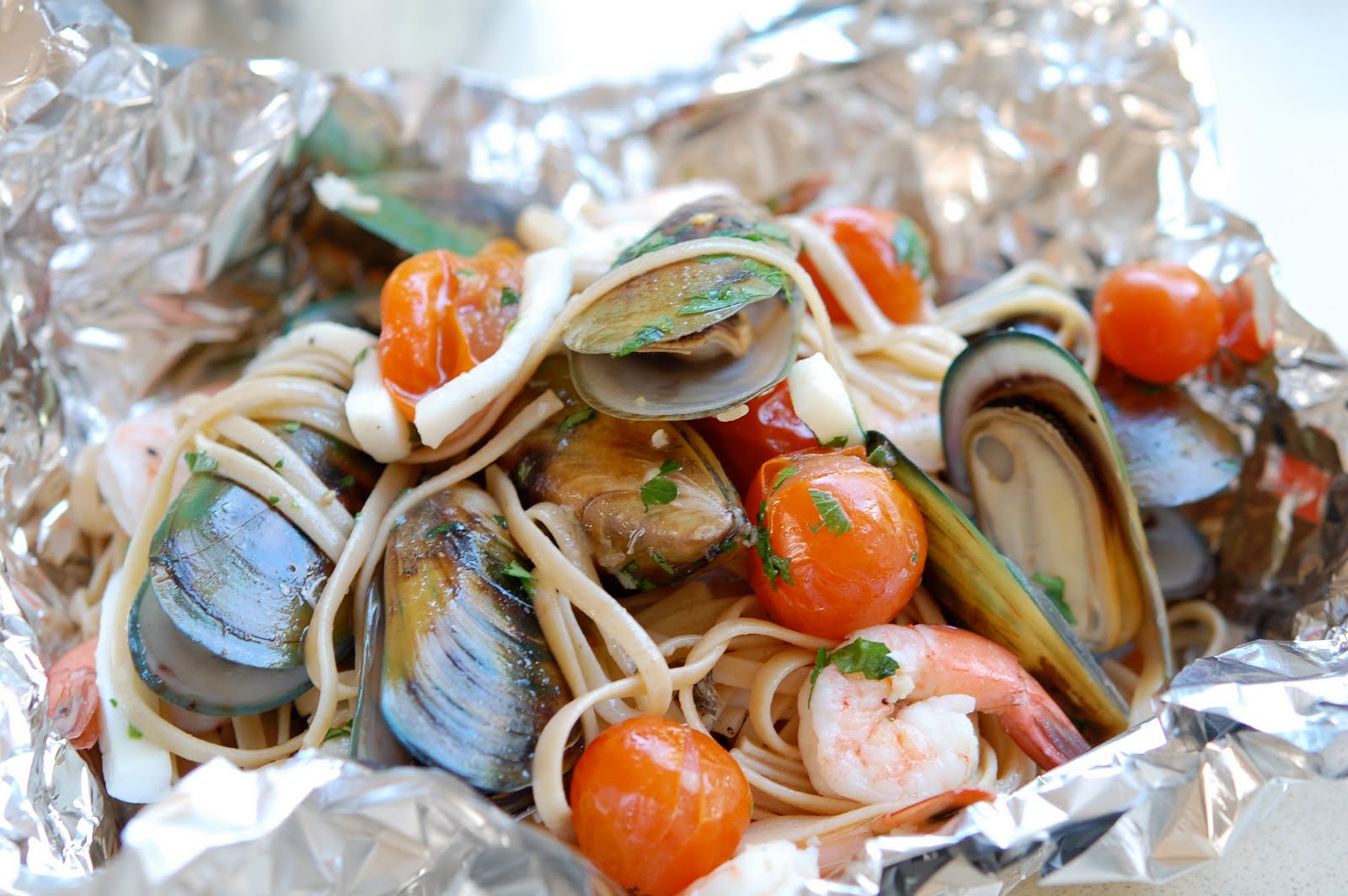
Baked prawn, calamari and mussel linguini


The cool thing about this recipe is that you can cheat. You can cheat as much as you want. For example, on Sunday I was nursing a fairly severe hangover so I bought already cooked prawns. Normally that's a bit of a cop-out for me but at that stage I honestly didn't care. You could buy frozen prawns that have already been peeled, or you could buy the real deal, cook them properly and de-shell them yourself. How much effort you go to with the mussels is up to you too. If you want to put on boots and scrape them off the rocks in Simon's Town by all means, go ahead. They will taste sensational. Because of the already-mentioned hangover I just bought some from Woolies. (Yip, you can do that now). They were green-lipped beauties from New Zealand and because this recipe calls for steaming them they were done in 5 minutes. 

Stuff you'll need to feed 2:
  • 2 x 150g calamari steaks
  • 400g of mussels
  • 400g of cooked prawns (if you buy raw ones, pan fry them until they are pink)
  • 250g of whole wheat linguini, spaghetti or other long pasta
  • A punnet of cherry tomatoes
  • 2 garlic cloves, finely chopped
  • 1 chilli, finely chopped 
  • A handful of parsley, roughly chopped plus extra to garnish
  • 2 lemons, cut into wedges
  • Tin foil
  • A few shavings of pecorino
Okay, what to do:

1. Preheat your oven to 200 degrees celsius. When ready, place your cherry tomatoes in a baking dish, drizzle with olive oil and season with sea salt and black pepper. Roast for 4o minutes, shaking every now and then. 

2. In a very hot pan, fry your calamari in the chilli and garlic for 2 minutes per side. NO MORE. Remove and set aside. When cool, cut into strips. 

3. Cook the pasta as per packet instructions. Drain, reserving about half a cup of the cooking water. 

4. In a bowl, mix the tomatoes, the pasta, the prawns, the calamari and the mussels. Add some of the water from the pasta. Throw in the parsley. 

5. Tear two thick pieces of tinfoil and lay them on a work surface. Carefully spoon half of the pasta and seafood mixture into the middle of the foil and using another piece fold in to create a "parcel". Before closing, divide the lemon wedges and throw them in. Close the parcel, making sure it is airtight. Repeat so that you have two pillowcase-looking foil parcels. 

6. Place them in the oven and cook for 5-7 minutes. Remove and carefully peel back some foil to see if the mussels have opened. Return to oven if necessary but be careful not to overcook the seafood. Really, you just want the mussels to open and the flavours to all infuse a bit. 

7. To serve, place parcels in a deep bowl, slash open the foil, add the pecorino, pour in some olive oil and extra parsley and eat. Glory. 

The thing here is not to be scared of the mussels. With all the moisture in the parcels they should open up pretty quickly. BE SURE TO CHUCK OUT ANY THAT DO NOT OPEN!!!! If you try and eat them chances are you will end up in hospital with seafood poisoning. That will really ruin the vibe. 

A nice touch would be to add a splash of wine into the parcel before cooking but my hangover wouldn't allow me to smell wine, let alone eat or drink it. 

Cheers,
Jamie Who

P.S. You can also serve this by carefully sliding the pasta into a deep bowl once cooked. It's not as dramatic but it does look a bit more elegant. 

Monday, April 26, 2010

Beef and wild mushroom stew served on butternut and celeriac mash


I had a good giraffe (laugh) the other night, watching TV. There's a show on BBC Food which is all about how some people are scared of food. Like, properly terrified of it. The particular episode I watched had a dude who freaked out every time you brought fruit or vegetables anywhere near him. I'm not kidding. He started sweating, shut his eyes and blocked his ears. It was truly bizarre and I laughed unashamedly. As the programme went on I realised it wasn't supposed to be funny. Not that this made me stop laughing. What was interesting to me was the reason the guy was so scared of the fruit and vegetables. You see..he didn't know what they were. He was scared of the unknown. Once I had figured this out the show became a lot more interesting to me. I say this because I am constantly trying to explain to people not to be scared of food. You can't learn unless you try things. Use ingredients you aren't familiar with. Buy whole foods and unusual cuts of meat. Get inventive. You'll find out soon enough the recipes you can come up with are limitless. 

A good example of a strange looking ingredient is celeriac. I spotted some in Woolies the other day and used it to take a pretty standard dish to a level that made it interesting. Here's how:

Stuff you'll need to feed 2:
  • 400g stewing beef, cut into chunks (I used free-range)
  • 1 tin of tomatoes
  • Half an onion, sliced
  • A red chilli, roughly chopped
  • A handful of mixed wild mushrooms, roughly chopped
  • Half a cup of red wine (I used Cloof Very Sexy Shiraz. Use whatever you like but I do like the way a shiraz has the spiciness to support this dish)
  • Half a cup of water
  • 2 cloves of garlic, crushed
  • A handful of parsley, roughly chopped
  • 1 celeriac bulb, skin removed and cut into cubes
  • 1 butternut, skin removed and cut into cubes
  • 2 teaspoons of paprika
  • A pinch of cayenne pepper
  • A handful of parsley, roughly chopped with extra for garnish 
Okay, what to do:

1. Preheat your oven to 20o degrees celsius. In a deep pot fry your beef in olive oil until browned. Remove meat and set aside. 

2. Add onion and the mushrooms to the pot along with the red wine. Cook for a minute and add the garlic and chilli. Cook for another minute and add the tomatoes and the water. 

3. Return meat to pot, bring liquid to the boil and reduce heat to a simmer. Cook on a medium to low heat with the lid on for as long as you can. (3 hours or more is ideal. If you don't have time make sure it is at least 1 hour. Anything less and the meat will be tough). About 45 minutes before serving remove lid to allow liquid to reduce and thicken. Add the parsley at this stage. 

4. Place the butternut and celeriac in a roasting tray. Drizzle with olive oil and add the paprika and cayenne pepper. Season with sea salt and black pepper and shake to make sure vegetables are covered. Cook for 20 minutes, remove and shake. Cook for 25 minutes more, remove and mash. 

5. To serve spoon celeriac/butternut mash into deep bowls and pour over some of the stew. Garnish with parsley. 

The celeriac is a funny-looking thing but it adds a great depth of flavour when combined with butternut. Together they work as a beautiful alternative to mashed potato and visually the dish is more attractive. How smooth you make the mash is up to you. Personally I like to leave it looking a bit rustic - I think the extra texture is a bonus. Of course, it's also a lot healthier than mashed potatoes which is another plus. 

There you have it. A nice little winter dish with an ingredient that you really have no right to be afraid to use. Give it a shot. What's the worst that could happen?

Cheers,
Jamie Who

Friday, April 16, 2010

Quinoa salad with roast beetroot and caramelised onions.


Ok my lovelies, this entry is probably going to be my shortest ever. I'm extremely busy and have an important meeting to get to. Look it's at Caveau and yes, I will be drinking but don't you DARE feel like I am neglecting you to rush off and get drunk. You know I love you. So much. Kisses. 

Annnyway, here's what you'll need to feed 4:
  • A cup of quinoa 
  • 6 baby beetroots, quartered
  • 2 onions, peeled and quartered
  • A handful of flat-leaf parsley, roughly chopped
  • A handful of basil, ripped
Okay, what to do:

1. Preheat your oven to 200 degrees celsius. Drizzle some balsamic vinegar and sea salt over the beetroot and onions and roast for 45 minutes. 

2. Meanwhile, cook your quinoa on the stovetop as per the packet instructions. 

3. When your vegetables are cooked, remove and allow to cool. Chop finely. 

4. In a large bowl mix the quinoa into the vegetables and add the parsley and basil. Add a good glug of olive oil (the best you have) 

5. To serve, place in the middle of a large plate. Drizzle some olive oil and balsamic vinegar around the salad. 

Told you it was going to be quick. Don't be fooled though, this salad will make you weep. It's that good. 

Now excuse me. Chardonnay and brainstorming awaits. And we all know how well those two go together. 

Cheers,
Jamie Who 

Monday, April 12, 2010

Whole wheat linguini with blue cheese, walnuts and wild rocket


Jeeeeeeeeez, I hate it when people say "oh this? I just made this with whatever ingredients I could find". Sure you did. That quail just happened to be in the freezer. So I understand if you're going to be pissed off with me starting this recipe with "I just made this from stuff I had lying around." But honestly, I did. See...I insist on having some cheese in the fridge. Good cheese. Strong cheese that smells. Unashamedly. Like it's proud to be stinky. Anyway, I had some unbelievable blue cheese in my fridge and (inspired by the classic waldorf salad) I used it as the base for this recipe. It is embarrassingly easy to make. 

As with any dish, the better the ingredients the better the dish. When it is this simple though, that philosophy is even more important. So get the best you can. 

Okay, stuff you'll need to feed 4:
  • A block of blue cheese the size of a tennis ball, torn into chunks. 
  • A packet of whole wheat linguini (or any long pasta) 
  • The zest of three lemons
  • A handful of walnuts
  • A big bunch of wild rocket 
Okay, what to do:

1. Cook the pasta as per the instructions. 

2. Drain pasta and add blue cheese immediately so it begins to melt. 

3. Add the lemon zest, the rocket and the walnuts. Stir through pasta to ensure everything is mixed properly. 

4. To serve, place in deep bowls and drizzle over some extra-virgin olive oil. (The best you have. I'm a big fan of Tokara and Willow Creek) 

Yip, that's it. Could be the easiest recipe I've ever put up here. Which is proof that tasty food doesn't have to be fancy food. 

Cheers,
Jamie Who

Wednesday, April 7, 2010

Mixed green vegetable salad


Part 2 in the Easter Feast special here. I am going to make this entry short mainly because it's supposed to show how easy the recipe is. Also, quite a big part of me wants to go drink a glass of Chardonnay at Cornuti. 

This is called the green vegetable salad because...umm...because that's what it is. I literally buy as much green shit as I can and throw it all into a salad. I was lucky enough to find some pumpkin seed sprouts at a food market so I added them. Obviously these are rare but you can use any microherbs as a substitute. Always top it off with some pumpkin seeds and shaved pecorino/parmesan or similar cheese. The visual contrast is pretty cool. 

Okay, stuff you need to feed 6: 
  • A few handfuls of rocket
  • A few handfuls of baby spinach
  • 2 Avocados
  • A handful of microherbs or your favourite herbs (flat-leaf parsley is a good one)
  • A bunch of tenderstem brocolli
  • A punnet of sugarsnap peas
  • A cup of frozen peas (This is one that I have no problem cooking from frozen)
  • About 5 medium-sized courgettes, sliced lengthways as thinly as possible
  • Some pecorino shavings 
  • A handful of pumpkin seeds
Okay, what to do:

1. Blanch your vegetables in boiling water. When done plunge them into a bowl of iced water. This will keep the electric green colour. 

2. Rub your courgettes with olive oil and cook over a braai or in a griddle pan. You want them to have charred lines. 

3. Throw your herbs into a big bowl and mix in the vegetables. Halve the avo, remove the pip and scoop the flesh out with a teaspoon. Add avo to bowl. Add some good olive oil and mix to ensure everything is coated. 

4. To serve arrange salad on a platter and garnish with the pumpkin seeds and cheese. Find the best balsamic vinegar you have and use it to dress. 

I sincerely hope you managed that one. If not, maybe we should just quit now. No hard feelings. Now if you'll excuse me, I'm off to get my drink on. 

Cheers,
Jamie Who

Tuesday, March 9, 2010

10 foods you thought were bad for you that actually aren't

The problem nowadays is that everyone has an opinion. Look, that's just my opinion. I find it's especially true when it comes to health though. You can pick up a magazine one day that tells you what is good/bad for you only to pick up a newspaper the following week with a totally contradictory article. It's tough and confusing. Over the years I have read lots of articles about foods that you thought were healthy but actually aren't. That's fine, but what I always want to tell people is foods that are supposed to be UNHEALTHY but are actually fine in moderation. Recently I was sent an article by The Other Guy Who Can Cook which deals with some of these food types. I think it was published in the UK Style magazine but can't be sure. I'm throwing a lot of my own interpretation in there too so it's not reaaaaaaallly plagerism. More like borrowing and adding. Yes, that's a much better way to put it. 

So here we go peeps, brace yourself for some good news. Here are 10 foods that you always thought were the devil. Turns out, they are actually really good for you. 

1. Cheese. Yes, I know cheese is high in fat. It's also high in calcium and certain proteins that carry amino acids, some of which have been linked to prevention of diseases like cancer. So as long as you don't eat a piece of camembert the size of a hockey puck every night you'll be fine. 

2. Chocolate. The theory behind chocolate being good for you is a little bit of a dangerous one. See...it has recently been argued that chocolate contains high levels of antioxidants which help prevent a number of things from heart disease to premature aging. This is true, but only partly. The antioxidants are really only found in high-quality dark chocolate (70% or more). So if you buy a cheap bar of chocolate and eat it because you read somewhere that it was healthy you're kidding yourself. As with cheese, you should only have a little bit of the good stuff. 

3.  Red meat. Again, it CAN be high in fat. But what is important is that it doesn't have to be. And with red meat it is easy to see when it is. Marbled meat is f-ing delicious but it is also higher in fat so be careful. Eat it sparingly and choose leaner cuts if you are trying to be healthy. 

4. Carbs. Who can honestly tell me they can survive without carbs? (If you answered "me" then piss off. You're lying.) Carbs are actually extremely important. The right type of carbs. It's all about sugar. With processed carbs, like white bread and sugary cereals, there is a surge in sugar levels followed by a very sudden crash which can lead to cravings.  Rather go for wholegrains, quinoa, oats etc. 

5. Dried fruit. Surely by now we all know you are supposed to eat 5 portions of fruit and vegetables a day. Come on, EVERYBODY knows that. The confusion comes with things like tinned fruit, frozen fruit and juices. Well, dried fruit is absolutely fine but because of the fact that it has "shrunk" you should just watch how much you are chowing. Dried fruit can give you fiber and plenty of minerals and vitamins. 

6. Avocadoes. I actually hope you already know these are good for you. Some people steer clear of them because of their high fat content but what they don't know is the fact that the fat in avo's is mono-unsaturated fat which is "the good fat". It helps with cholesterol, lowering blood pressure and on top of that most mono-unsaturated fats are packed with vitamin E. 

7. Butter. Most people think margarine is healthier than butter. Most people are wrong. They both contain similar amounts of fat. As with avo's it is the TYPE of fat that is important. True, most margarines are made from unsaturated fat but some contain transfats which is like the Hitler of fats. Honestly, you don't want to see transfats anywhere on a diet. Basically the deal here is neither butter nor fat is healthy, so use them sparingly. Definitely don't use margarine thinking you are taking the better option - that is not necessarily true. 

8. Coffee. I can't touch it, but research lately seems to be showing that a cup of coffee can speed up the metabolism process as well as the obvious other benefits of increasing endurance, performance and stamina. (sounds like the researchers mixed up their papers with the work they did on viagra)

9. Sugar. This is only healthy when compared to sweeteners. The problem with sweeteners is that when the body takes them in it prepares itself for more calories. If these don't arrive the body then needs more food or burns less energy. Both result in weight being added on, not lost. If you have to get a sweet kick, rather do it naturally.

10. Late-night snacks. For years the argument has been that if you eat late at night your body doesn't have time to burn off the calories. Common sense says that what is way more important is how many calories you eat throughout the day. If you go to bed having eaten less calories than you have burned, you are absolutely fine. So have a little something before you go to bed. Just don't have a big something. Simple, no?

Sho, that was quite a post. Maybe not as funny/interesting as some of my others but definitely something important that I feel strongly about. Food is there to be enjoyed and people need to keep that in mind. You can be health-orientated without deprivation. Just reward yourself with the good-quality products and eat them in moderation. 

Cheers,
Jamie Who

Monday, March 8, 2010

Grilled yellowtail served on fennel gazpacho


There is absolutely nothing wrong with a beautiful, chilled bowl of gazpacho. Except maybe for the fact that it is never really enough for me. It's fine as a starter but as a main I really do need more. So with this in mind I threw together this little dish last night. The plan was to leave the gazpacho very chunky so that it could double-up as a kind-of-sauce. It worked out pretty nicely...

Stuff you'll need to feed 2:
  •  About 450g of any firm white fish (I used yellowtail) 
  • A mixture of mustard seeds, coriander seeds and fennel seeds, all crushed
  • 3 tomatoes, quartered
  • One red onion, quartered
  • A bulb of fennel, quartered (keep the leaves too)
  • A tablepoon of red wine vinegar
  • One chilli, roughly chopped
  • Half a cucumber, peeled
  • About 100ml of water
  • A few tablespoons of olive oil
Okay, what to do:

1. Preheat your oven to the highest temperature. Rub fish in olive oil and cover with mustard seed mixture. 

2. Using a spoon remove the seeds from the cucumber and discard. Add cucumber, along with tomatoes, fennel, onion, olive oil, vinegar, chilli and water to a blender and pulse to form a chunky soup. Place in refrigerator. (The consistency is totally up to you. It can be as smooth or as course as you would like) 

3. Grill fish in oven for 8-10 minutes or until done. 

To serve, spoon gazpacho into bowls and place fish on top. Garnish with halved cherry tomatoes and fennel leaves. As a final touch drizzle over some extra virgin olive oil. 

Another healthy dish that's absolutely perfect for the heat we are going through at the moment. It's light and easy and the fennel adds an interesting dimension. Give it a bash. 

Cheers,
Jamie Who

Friday, March 5, 2010

Calamari, mango and coriander salad


Isn't the 1st of March supposed to be the start of Autumn? I thought so, but someone clearly forgot to tell whoever it is up there that controls the weather. You see...Cape Town has been off-the-charts hot this week. On Wednesday Icepick and I set out to do the Men's Health 10km race (cleaned it, obviously) and it was 35.5 degrees. What's the big deal? The race started at 18h15!!! Yeah, that's what we're dealing with down here. 

Don't get me wrong though, I'm not one of those people who moans about the heat. If I do feel the slight pang of "this is just too hot" I do a quick Google search for temperature in London and see how the expats are doing over there. 9 degrees. Yeah...

It's pretty chilly here today too. 28.5 at the moment. Annnnyway, the point is when it gets this hot I turn to light, easy salads for dinners. I keep the flavours clean and try and spend as little time cooking as possible. That was the gameplan last night and this popped out. A lovely little dish. Check it out. 

Stuff you'll need to feed 4:
  •  800g calamari tubes, cut into strips
  • 2 - 3 mielies (cobs of corn)
  • A handful of cashew nuts
  • 2 big handfuls of mixed lettuce (different colours, shapes, textures etc)
  • A handful of coriander, roughly chopped
  • 2 mangos, peeled and thinly sliced
Okay, what to do:

1. In boiling, salted water cook the corn for a few minutes until done. Slice the corn to remove the kernels.

2. In a dry pan roast the nuts for a few minutes. Be very careful not to burn them. It's quite easy to do so keep an eye on them and shake the pan often. Remove and allow to cool. 

3. Place the lettuce leaves, the coriander, the mango, the nuts and the corn in a bowl.  

4. Heat a wok (or big pan) until smoking hot and cook the calamari in vegetable/avocado/sunflower oil (olive oil won't work here) for 1-2 minutes. Do not overcook it.  Add the calamari to the bowl. 

5. Season with salt and black pepper and serve immediately, before the calamari has a chance to wilt the leaves. 

I didn't make a dressing which was a big a mistake but I just used some soy sauce and honey to drizzle over, which was a pretty good save. If you've got lemons that would be good too. The whole thing took about 10 minutes and was absolutely perfect for a quick, healthy summer dinner. Loving it. 

Cheers,
Jamie Who

Monday, February 22, 2010

Chicken and wild mushrooms braised in white wine


I normally start giving some thought as to what I'm going to write for you lovelies somewhere on my way to work in the morning. This morning was different though, and as I stood admiring myself naked in a full-length mirror, I knew what I was going to write even before I had time to exfoliate. You see...it was raining. And I have just the thing for a rainy day. Look, it's not the prettiest dish you'll find here but in terms of taste it's hard to beat. And perfect - absolutely bloody perfect - for a cold night when you just feel like no-hassle cooking. 

Stuff you'll need to feed 4:
  • About 800g of organic, free-range chicken pieces (I use skinless. Try and get the thigh meat, otherwise get chicken on the bone.)
  • A handful of cherry tomatoes
  • A cup of white wine
  • A cup of water
  • An onion, finely sliced
  • A handful of mixed wild mushrooms
  • 2 Tablespoons of fresh thyme
  • 2 Tablespoons of fresh rosemary, roughly chopped
  • 2 cloves of garlic, finely sliced
Okay, what to do:

1. Pre-heat the oven to 160 degrees celsius. 

2. In an oven-proof pan or casserole dish gently fry the onions, mushrooms and garlic in a little olive oil. You want the onions to soften but not colour and you don't want to burn the garlic so make sure the heat is not too high. 

3. After about 2 minutes add the chicken pieces and the herbs and fry for about 1 minute. Add the water and the wine and increase the heat. Bring to a boil and reduce back to a simmer. 

4. Add the tomatoes, season well with black pepper and sea salt and cover the pan/dish with a lid or damp wax paper. Place in the oven and cook untouched for about an hour and fifteen minutes (maybe an hour and a half, depending on your oven). 

5. Remove the pan/dish from the oven and cook gently on the stovetop to reduce the sauce to your desired consistency. You can have it as thick as you want, depending on what you are serving it with (quinoa, couscous, brown rice and lentils are good options). 

So...that's it. There's an expression that says if something is too good to be true it probably is. Not here though. Here it really is that easy. And healthy. And f-ing delicious. Enjoy it. 

Cheers,
Jamie Who 


Sunday, February 14, 2010

Sichuan pepper calamari salad


I got the idea for this dish from Kylie Kwong, who has to go down as one of my all-time favourite chefs. Her philosophy is to bring Asian techniques into Western cookery and she does this by showing us that real Chinese cooking isn't all about sticky sweet and sour pork, MSG-packed sizzling beef and some chicken and stale cashews served in a gooey sauce. It's more about clean, simple flavours that showcase the main ingredieent of the dish. She is very clear about the fact that quality of ingredients is absolutely vital. I'm a big fan of this approach to food and love her "less is more" vibe. 

Last week I had some fresh calamari steaks and didn't really know what to do with them. I ended up adapting one of her dishes and the whole thing took about 10 minutes from start to finish. The end result was a beautifully balanced, light warm salad. 

Stuff you'll need to feed 2:
  • About 400g fresh calamari steaks
  • A quarter of a cup of cornflour
  • Canola oil (I like using this oil for this dish as olive oil is a bit overpowering)
  • A handful of coriander, finely sliced (use the stalks and roots) 
  • 2 tablespoons of spring onion, sliced diagonally
  • About a thumb-sized piece of ginger, finely sliced
  • 1 - 2 chillies, finely chopped
  • 1 - 2 cloves of garlic, finely sliced
  • About a teaspoon of sea salt
  • 2 teaspoons of Sichuan pepper (you can find this in any Asian store but I think places like Woolies and Pick 'n Pay are stocking it now too)
  • A head of iceberg lettuce, finely sliced
  • 2 lemons, cut into wedges
  • A packet of rice noodles, soaked in boiling water as per packet instructions
Okay, what to do:

1. Score your calamari steaks to make criss-cross patterns. Be careful not to break through the skin. 

2. In a bowl, combine the calamari and cornflour to coat. Shake off any excess flour. 

3. Heat some canola oil in a wok (or the biggest pan you have). Wait until the oil is extremely hot and cook the calamari steaks for about 1 minute per side. 1 minute guys, that is all it will take. Please don't be tempted to cook it longer. Remove calamari, cut into pieces diagonally and set aside. 

4. Add the coriander, spring onions, ginger, chilli and garlic to the wok and stir fry for another minute. Return squid and add the sea salt and Sichuan pepper (leave a bit for garnish). Stir-fry for 30 seconds and you're done. 

5. To serve, place a handful of noodles in one half of a bowl and shredded lettuce in the other. Top with the calamari mixture and finish by sprinkling over some Sichuan pepper and squeezing over some lemon juice. 

This dish is healthy, fresh and ridiculously easy. The only thing that can go wrong is if you overcook the calamari. It will be tough, tasteless and generally pretty average. Just have a bit of faith and pull it off early. As a worst-case scenario you can chuck it back on if you need to. 

Cheers,
Jamie Who

Tuesday, January 26, 2010

Prawn and coriander pizza


Last week Icepick jumped in at the last minute to babysit Elvis as The Queen and I headed off to an overnight party in Franschhoek. To thank him I had him round for dinner on Monday and decided to make pizza. I did them in a little portable braai called a Buzbee and if you're clever you'll click here and order one. It's an awesome toy. A portable braai that you can grill, roast and bake on. You can take it to the beach or put it in the middle of your dining room table. It's pretty skoochie. If you don't want to go that route you can try and cook your pizzas on a clay tile in the Weber or buy yourself the pizza plate especially made for Weber. Or, if you are boring or if it's raining you can just cook them in your oven. Let me just say it won't be anywhere near as good but hey, it's your call. 

What toppings you put on is totally up to you and if you want to buy pre-made pizza bases or dough then do that. I'm not judging (I am actually). 

Okay, what you'll need to make the dough (enough for about 4-5 medium pizzas)
  • 500g bread flour
  • A 7g sachet of dried yeast
  • About a tablespoon of sea salt
  • Half a tablespoon of caster sugar
  • 325ml of lukewarmwarm water
  • 2 tablespoons of olive oil
What to do:

1. Sieve your salt and flour onto a floured work surface and make a "well' in the middle. 

2. Combine your water, olive oil, sugar and yeast in a jug and leave for about 5 minutes. 

3. Slowly add the water to the middle of your well and with a fork bring in the flour from the outside-in. Carry on with this process until the dough starts coming together and gets solid. Flour your hands and start kneading the dough using the palms of your hands. Do this until you are left with a springy, smooth ball. 

4. Put you dough in a bowl, cover with a bit of flour and place a damp dishcloth over the bowl. Leave in a warm spot for about an hour. 

5. When you're ready, take the dough out and knead it a bit more, knocking out the excess air. Then cut the dough into as many balls as you need (1 ball per pizza obviously guys)

6. 20 minutes before you want to cook the pizzas, flour the work surface again and roll out the balls to the appropriate thickness. If you want to do this in advance you can - just place floured wax paper over each pizza base and stack them in the fridge. Don't roll out the bases and leave them lying around or they will dry out badly. 

To make your tomato sauce:

1. Roast about 500g of cherry tomatoes in an oven at 200 degrees celsius with some olive oil and dried herbs for 30 minutes or until done. Remove and place in a blender. Once blended, add the tomatoes back to a pan with a tin of tomatoes, three sliced cloves of garlic and one sliced chilli. Cook over a medium heat until the sauce thickens and reduces to the right consistency to allow it to be spread over the bases. 

Okay, so you've got your pizza bases and your tomato sauce. From here what you add is really your call. I panfried some prawns but do whatever you want. Once you have your toppings here's what you do:

1. Spread some sauce over your pizza base. Not too much, just enough to lightly cover it. 

2. Add a few toppings (olives, bacon, pesto, chicken etc.)

3. Tear up some mozzarella and dot it around the pizza. Again, not too much - if you add too much the pizza will be impossible to handle. 

4. Place the tile/skillet or whatever in the Weber and allow to get white hot. Transfer the pizza and cook with the lid on for about 10 minutes or until done. You want a slightly charred base and the cheese needs to be bubbling. 

5. Remove and garnish with your favourite herbs. I went for coriander and rocket but just use your favourite. 

Jeeeeeeeez, that was a hectic entry. I will say this though, the pizza was f-ing amazing. There is a strange satisfaction eating a pizza you've made from scratch. I also felt a bit smug knowing that it wasn't actually unhealthy at all. Not like the greasy processed stuff you get when you pick up a phone and order a delivery. If you prefer doing that...well...you're reading the wrong blog. 

Cheers,
Jamie Who

Thursday, January 21, 2010

The Queen's Hake kebabs


Last night I got home and The Queen was busy knocking up these kebabs for dinner. After fake-helping and watching her do about 99% of the work I jokingly asked her if she would be bummed if I blogged and claimed the recipe to be mine. She asked me if I would like a foot up my ass. Aaaah, marriage. It's truly a magical thing. So guys, make no mistake. These kebabs (delicious by the way) are hers. Let's appreciate that. 

Stuff you'll need to feed 2:
  • About 400 of firm white fish, skinned and cut into bite-sized pieces (we used hake owing to the fact that it is on the green list)
  • A handful or two of cherry tomatoes
  • A few pieces of black forest ham, cut lengthways (or bacon if you want, we were keeping it as healthy as possible)
  • A handful of courgettes, sliced lengthways as finely as possible
  • A few wooden skewers
  • A bowl of mixed lettuce leaves (look for different colours, sizes, shapes and textures)
  • A handful of mixed sprouts
  • 2 lemons, zest removed
  • Two tablespoons of mixed dried herbs (thyme, basil, oreganum etc.) 
  • A handful of fresh rosemary, roughly chopped
  • 1-2 chillies, sliced on the diagonal
  • 2 cloves of garlic, finely chopped
Okay, what to do:

1. Soak the skewers for about 30 minutes to prevent them from burning. Turn your grill on to maximum heat if cooking in the oven, (They taste waaaaay better cooked on a braai though).

2. In a pestle and mortar add a few glugs of olive oil, the garlic, the lemon zest, the rosemary and mixed herbs. Bash up the mixture to create a rough paste.  (If you don't have a pestle and mortar don't stress. Just mix the stuff together in a bowl.)

3. Thread a courgette slice onto the skewer, wrapping it around a piece of fish. Add a slice of ham and double them both back over. Add another piece of fish and wrap the ham and courgette back around it. (See picture to get the vibe). Add a cherry tomato and repeat the process until the skewer is loaded up and good to go. 

4. Place the skewers in a baking dish and pour over the marinade. Leave for about 30 minutes. Just before cooking add juice of one lemon. 

5. Cook for a few minutes under the grill or on a braai. They are done when the bacon/ham is crispy, the fish is white but still moist and the tomatoes are blistering. This won't take long guys. Please don't overcook the fish. Rather take it off for a taste early. You can always put it back on for more. 

6. Meanwhile make the (ridiculously easy) salad by combining the lettuce, the chilli, the sprouts and the juice of the second lemon. Season well with black pepper. Throw on a bit of olive oil too. 

7. To serve, spoon out the salad and cross the kebabs over each other. 

In terms of health and nutritional value you will be hard-pressed to beat this one. Throw in the fact that it tastes like rainbows and you've got a winner. Enjoy it peeps. And if you ever bump into The Queen just be sure to mention how f-ing good those kebabs of hers were. Cool, I owe you a solid. 

Cheers,
Jamie Who

Friday, January 15, 2010

Mushrooms on toast


I am always struck by the beauty of simple food. With chefs constantly learning and experimenting there is still something strangely appealing about an old classic. Don't get me wrong, I am always keen to hear about a new cooking technique or admire a dish that is plated up in a way I haven't seen before, but honest cooking with quality ingredients is a style that I always enjoy most. With this in mind I got my hands on some beautiful mushrooms and went to work. 

Stuff you'll need to feed 2:
  • About 250g - 300g of mixed wild mushrooms (I used porcini, king oyster, shiitake and enoki. Feel free to use what you like but please don't try this dish with just button mushrooms. I'm telling you know it will be average.) Keep the smaller ones whole and try not to cut any of them to much. I like the rustic nature of bigger chunks of 'shroom. 
  • About a quarter of a cup of water
  • About 3 tablespoons of the best balsamic vinegar you can find
  •  2 cloves of garlic, finely sliced
  • A handful of chives, finely chopped
  • A tablespoon of thyme (dried is fine)
  • 2 - 4 soft boiled eggs, peeled. (Boiling an egg to perfection is actually quite difficult and depends widely on the stove but as a guideline do this: Bring a pot of water to the boil and reduce the heat to a simmer. Cook the eggs for 4-5 minutes and remove from water to allow to cool. That should get you close. Obviously the way you like your eggs will dictate times so just play around a bit.)
Okay, what to do:

1. In a little olive oil fry off the garlic for about a minute. Do not let it brown though. Just cook gently. 

2. Add the mushrooms and thyme and cook for about a minute. Add the water, the balsamic and season generously. 

3. Increase the heat and cook for about 8minutes or until your balsamic has reduced to a gorgeous thick sauce. 

To serve, spoon the mushrooms onto your favourite toasted bread. (I'm a big fan of a sourdough/rye combo). Add either one or two soft boiled eggs onto the mushrooms and break open to allow the yoke to run into the mushrooms. Garnish with chopped chives. I served mine with some tomatoes roasted on the vine. A nice touch yes? 

The key to this dish (obviously) is the quality of produce. With something this simple you need the best. If you can find that, you have got a winner. I know a lot of you will want to fry the mushrooms in butter but do you know what I want...I want you drop and give me 20. The butter is unnecessary. Now go run somewhere. 

Cheers,
Jamie Who 

Thursday, January 14, 2010

Trout tartare with ponzu dressing


I can't believe how hot it was yesterday. I got back from gym and my sweat was sweating. After a shower (cold) I actually couldn't deal with the thought of cooking. I had two gorgeous trout fillets and figured I would make a little tartare. I used ponzu sauce as the main ingredient for the dressing. I love that stuff. Ponzu is a Japanese, citrus-based sauce that I mixed in with soy sauce and sesame oil. I was extremely stoked with the results. Let's check it out.

Stuff you'll need to feed 2:
  • About 400g of fresh trout (just get two fillets with the skin on)
  • Half a cup of ponzu sauce
  • Half a cup of soy sauce
  • A few drops of sesame oil
  • A dash of honey
  • A handful of chives, finely chopped
  • A handful of coriander, finely chopped
  • A lemon
  • A bulb of fennel, finely sliced
  • Two avocados
  • A teaspoon or two of sesame seeds for garnishing
Okay, what to do:

1. Start by peeling the avocado and cutting into cubes. Squeeze the juice from one half of the lemon over the avo to stop it turning brown and put it in the fridge. 

2. Remove the trout's skin by peeling back the skin and using a sharp knife to follow it along the bottom of the fish. Once this is done, chop the trout into small pieces. (How small exactly is up to you.)

3. Place the trout in a bowl and add the ponzu, the soy, the sesame oil, the juice from the other half of the lemon, the coriander and the chives. Season with cracked black pepper. You probably won't need to add salt because of the ponzu and soy but if you have to then go ahead. Mix everything up and refrigerate for about 10 minutes. (Don't leave it longer or the lemon juice will start to cook the trout)

4. Find something in your kitchen that is a good size and shape and rub a bit of olive oil on the inside. Pack the trout tightly into the container. Put a plate over your chosen container and flip it over quickly. Put some avocado over the top of your trout and sprinkle some sesame seeds over the top. Drizzle some ponzu sauce around the plate and finish with a bit of the fennel. 

What a perfect dish for summer. Healthy, tasty and not even necessary to turn a stove on. The fennel - if I do say so myself - was an incredible touch. I'm not going wank on and on about fennel because I feel like I do that every time I cook with it but it really was amazing with the other clean flavours. With hindsight, I would've added a bit of chilli into the mix though. Aaah well...next time. 

The smarter of you will notice that there are TWO photos of the tartare. That is a result of The Queen's competitive streak coming through (as it does) and her being convinced she could present the dish in a better way. I'll let you be the judge. 

Cheers,
Jamie Who